
Pocket money can be one of the most powerful tools you use to teach financial literacy at home. When done intentionally, it transforms from “just giving kids money” into a practical, real-life money lesson.
In this guide, you’ll learn:
- What pocket money (allowance) really is
- Who should receive it
- The purpose behind giving it
- Pros and cons of pocket money
- How much to give by age
- What kids can do to earn it
- How to turn allowance into a simple money plan
Let’s break it down.
What Is Pocket Money (Allowance)?

Pocket money — also known as an allowance — is a small, regular amount of money given to a child by a parent or caregiver.
The purpose is not to “spoil” children. It’s to create a safe practice environment for learning how money works.
Allowance allows children to:
- Make spending choices
- Learn from small mistakes
- Practice saving
- Experience delayed gratification
- Develop responsibility
It’s hands-on financial education.
Who Can Get Pocket Money?
There is no universal rule, but most families introduce pocket money between ages 5 and 7.
Children who are ready for allowance typically:
- Understand basic counting
- Can identify coins or digital balances
- Show interest in buying things
- Can follow simple rules
There is no “perfect age.” The better question is:
Is your child ready to learn through experience?
What Is the Purpose of Pocket Money?
The real purpose of allowance is to:
- Teach budgeting
- Encourage saving habits
- Build decision-making skills
- Create financial independence
- Introduce earning concepts
Allowance is not just about spending. It’s about structured learning.
When paired with a plan, pocket money becomes the foundation of lifelong money management.
Pros and Cons of Giving Pocket Money
✅ Pros of Pocket Money
1. Teaches Financial Responsibility
Kids learn money is limited and choices matter.
2. Encourages Delayed Gratification
Saving for a larger goal builds patience.
3. Builds Confidence
Managing their own money creates independence.
4. Reduces Impulse Requests
When kids use their own money, “Can you buy me this?” often decreases.
5. Creates Real-Life Budget Practice
Budgeting is easier to learn with real dollars.
❌ Cons of Pocket Money
1. Entitlement Risk
If not structured, children may expect money without responsibility.
2. No Financial Learning Without Guidance
Simply handing over money without teaching a system defeats the purpose.
3. Inconsistency Can Cause Confusion
Irregular payments make planning difficult.
The solution?
Structure + consistency + clear expectations.
How Much Pocket Money Should I Give My Child?
There is no one-size-fits-all amount. It depends on:
- Your family budget
- Your goals for teaching money
- Your child’s age
- What the allowance is expected to cover
Common Guidelines by Age (Weekly)
- Ages 5–7: $3–$7
- Ages 8–10: $7–$12
- Ages 11–13: $12–$20
- Teens: Adjust based on responsibilities and covered expenses
Some parents follow the “$1 per year of age” rule, but this is flexible.
The key is this:
The amount should be enough to allow meaningful decisions — but small enough that mistakes are safe.
Should Kids Earn Their Pocket Money?
There are two common approaches:
1️⃣ Base Allowance + Bonus Chores
Children receive a small base allowance.
Extra tasks earn additional money.
2️⃣ Fully Earned Allowance
Children must complete agreed responsibilities to receive payment.
There is no universally correct method. What matters is consistency and clarity.
What Should My Kids Be Doing to Get Pocket Money?
Allowance should connect to contribution — not punishment.
Age-appropriate responsibilities might include:
Ages 5–7
- Tidy toys
- Feed pets
- Help set the table
Ages 8–10
- Load dishwasher
- Fold laundry
- Sweep floors
Ages 11–13
- Vacuum
- Cook simple meals
- Babysit siblings (short periods)
If you’re unsure what tasks are suitable for each age, you can download the free Mastering Age-Appropriate Chores Blueprint to get a complete breakdown of responsibilities by developmental stage.
This ensures your child builds life skills alongside money skills.
How Pocket Money Supports Simple Money Planning
This is where allowance becomes powerful.
Without a plan, pocket money disappears.
With a simple money plan, it builds skills.
Step 1: Divide Into Categories
The easiest structure is:
- 💰 Save
- 🛒 Spend
- ❤️ Give
- Tax
This creates automatic budgeting habits.
Step 2: Set a Savings Goal
Example:
- $60 bike
- $40 game
- $25 toy
Now the child can calculate:
“How many weeks will it take?”
This introduces:
- Planning
- Goal tracking
- Basic math
- Delayed gratification
Step 3: Track the Money
Children can:
- Use jars
- Use envelopes
- Use a printed tracker
- Use a simple spreadsheet (for older kids)
Tracking builds awareness — awareness builds control.
Turning Allowance Into a Simple Weekly Money Plan
Here’s a basic example:
Child receives $10 per week.
They divide:
- $4 Save
- $5 Spend
- $1 Give
After 10 weeks:
- $40 saved toward a goal
This is budgeting in action.
Over time, children learn:
- Money flows in
- Money flows out
- Planning changes outcomes
“If you’d like a done-for-you system that includes printable trackers, chore charts, savings planners, and a step-by-step framework to turn allowance into a complete money plan, the Allowance Blueprint walks you through exactly how to implement this at home.”
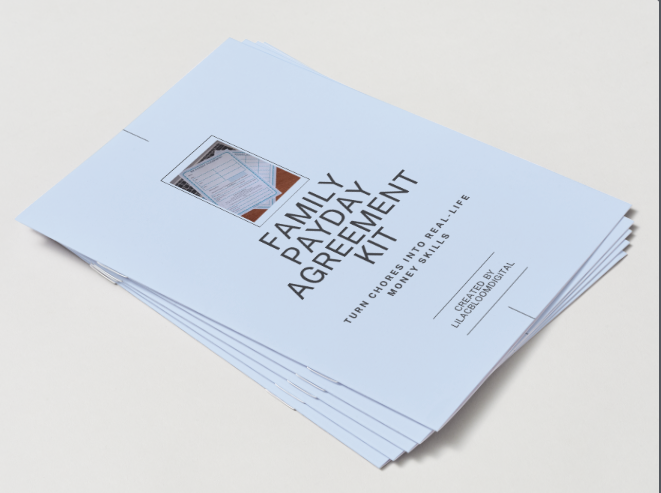
Family Payday Agreement Kit
Turn everyday chores into real-life money skills with the Family Payday Agreement Kit. This simple, printable system helps kids earn, save, and manage money while building responsibility — without nagging or arguments.
Frequently Asked Questions
Is pocket money good for kids?
Yes — when paired with guidance and structure. It teaches real-world financial skills in a safe environment.
Should allowance be tied to chores?
It depends on your parenting philosophy. Many families use a hybrid model of base allowance plus bonus earning opportunities.
Can pocket money teach budgeting?
Absolutely. In fact, allowance is one of the simplest ways to introduce budgeting before children earn part-time income.
What if my child spends it all immediately?
That’s part of the lesson. Small financial mistakes teach powerful long-term discipline.
The Bigger Picture: Allowance Builds More Than Money Skills
When used intentionally, pocket money develops:
- Responsibility
- Patience
- Planning
- Confidence
- Work ethic
- Gratitude
It’s not about raising children who love money.
It’s about raising children who understand it.
🚀 Start Your Family Payday System Today
If you want your child to:
✔ Understand money early
✔ Take responsibility for their tasks
✔ Stop constantly asking for money
✔ Build real-life financial habits
You need more than allowance…
You need a system.
👉 The Family Payday Agreement Kit gives you a simple, step-by-step way to make this happen.
💡 No more guessing
💡 No more inconsistency
💡 Just a system that works
👉 Start your family payday today
Family Payday Agreement Kit
Turn everyday chores into real-life money skills with the Family Payday Agreement Kit. This simple, printable system helps kids earn, save, and manage money while building responsibility — without nagging or arguments.