
Teaching kids about money doesn’t start with saving — it starts with earning, structure, and consistency.
If you want your child to understand the value of money, responsibility, and financial decision-making, you need more than random pocket money…
👉 You need a system.
In this guide, you’ll learn how to use a Chore Scoreboard + Payday Agreement to help your child:
- Earn their own money
- Build responsibility
- Learn real-life money habits early
💡 Why a Chore Scoreboard Works

Kids thrive on visual progress and routine.
A chore scoreboard:
- Turns chores into a clear earning system
- Builds consistency and accountability
- Creates motivation through visible progress
- Gives kids a sense of ownership over their money
👉 This isn’t about “helping around the house” — it’s about building life skills.
📝 Step 1: Set Up a Payday Agreement (The Foundation)
Before your child earns anything, you need structure.
A Payday Agreement is what turns chores into a real-world system.
What to include:
✔ 3 weekly jobs (clear and age-appropriate)
✔ Agreed weekly pay amount
✔ Clear expectations (what happens if tasks aren’t done)
✔ Parent + child signature (this matters more than you think)
💡 Why this matters:
Without a clear agreement, kids see money as random.
With a system, they see money as something they earn and manage.
📊 Step 2: Create Your Chore Scoreboard
Now it’s time to make progress visible.
Your Chore Scoreboard is a simple tracker that runs over a 10-week period.
How it works:
- List the 3 agreed jobs
- Track completion daily or weekly
- Tick off tasks as they’re completed
Why this is powerful:
That simple ✔ tick creates a dopamine reward loop — helping kids stay motivated and engaged.
👉 You’re not just tracking chores — you’re reinforcing behaviour.
💰 Step 3: Introduce the Payday System (Where the Real Learning Happens)
This is where most parents stop… but this is where the magic is.
Earning money is only step one.
Managing it is the real lesson.
Use the 4 Jar Money System:
💸 10% Tax Jar
Teaches that a portion of income always goes elsewhere (real-world concept)
💰 Saving Jar
For bigger goals and delayed gratification
🛍 Spending Jar
For wants and everyday choices
💛 Giving Jar
To build generosity and awareness
👉 This system teaches kids how to:
- Budget
- Plan
- Prioritise
- Delay gratification
🚀 Why This System Builds Lifelong Money Habits
When your child:
- Tracks their work
- Earns their money
- Splits it intentionally
They are using their prefrontal cortex (decision-making part of the brain).
This builds:
- Self-control
- Planning skills
- Financial confidence
💡 And here’s the key:
These habits are easiest to build before teenage years.
🧩 The Missing Piece Most Parents Struggle With
Most parents try to:
- Create chore charts
- Decide allowance amounts
- Explain money concepts
…and end up overwhelmed or inconsistent.
👉 That’s because they’re building the system from scratch.
🎯 Want This Done For You? (Family Payday Agreement Kit)
If you want a ready-to-use system (instead of figuring it all out yourself), this is exactly what the:
👉 Family Payday Agreement Kit is designed for.
Inside, you get:
✔ Done-for-you Payday Agreement templates
✔ Chore Scoreboard trackers
✔ Clear step-by-step setup
✔ Simple scripts (what to say to your child)
✔ A complete system that actually works
💡 This isn’t just printables — it’s a repeatable system you can stick to.
👉 Grab the Family Payday Agreement Kit here
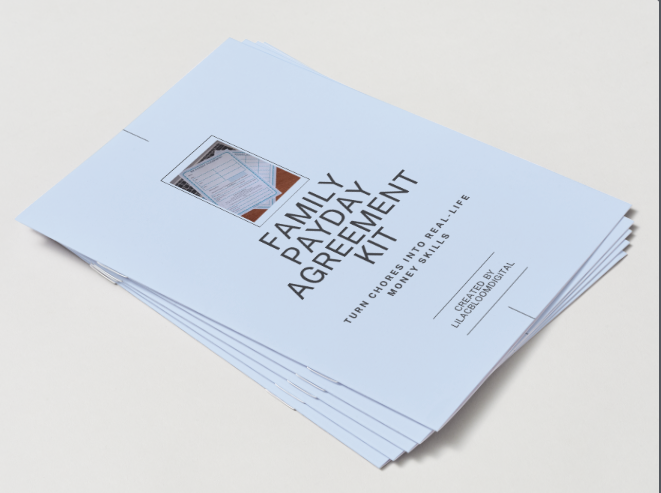
Family Payday Agreement Kit
Limited offer — discounted access available for a short time only. Once spots are filled, the price increases. Start your child’s financial literacy journey today.
Turn everyday chores into real-life money skills with the Family Payday Agreement Kit. This simple, printable system helps kids earn, save, and manage money while building responsibility — without nagging or arguments.
🎁 Not Ready Yet? Start With This Free Resource
If you’re just getting started, download:
👉 Mastering Age-Appropriate Chores Blueprint (FREE)
This will help you:
✔ Choose the right chores by age
✔ Avoid common mistakes
✔ Set your child up for success
👉 Download your free copy here
🌱 Final Thoughts: Small Systems, Big Impact
This isn’t about chores.
It’s about raising a child who:
- Understands money
- Makes smart decisions
- Feels confident managing their future
Start simple. Stay consistent.
And remember:
👉 The goal isn’t to raise a child who completes tasks…
It’s to raise an adult who can manage life.